Anyone with a guidebook and a map can work their way around the major attractions of a buzzing metropolis, but a day spent drifting from the Yu Garden to the Peace Hotel and back again isn’t likely to get you under the skin of Shanghai’s decadent chaos. It’s true, getting intimate with a silver-surfaced giant like this isn’t easy – but with a little insider knowledge and a healthy dose of daring, it’s easier than you might think.
***
Breakfast
Take the metro as far as Dapuqiao S (line 9), emerging onto the streets of the French Concession from exit number 4, then uncover the well-hidden entrance to Lane 248 on the opposite side of the street. Take a few steps and, as your eyes adjust to the darkness, you’ll find yourself instantly absorbed into a network of narrow, labyrinthine passages nestled within a gentrified block of old buildings. You are now in Tianzifang.
These Shikumen buildings – an architectural style combining Western and Chinese elements – date from the 1930s, and were part of a bustling low-income neighbourhood until threatened with demolition in 2006. Fortunately, several local business owners proposed that the unique enclave and its distinct architecture should be preserved, gradually attracting an ever more diverse array of arts and craft stores, cafés and restaurants, creating the cosy, bohemian quarter which exists today.
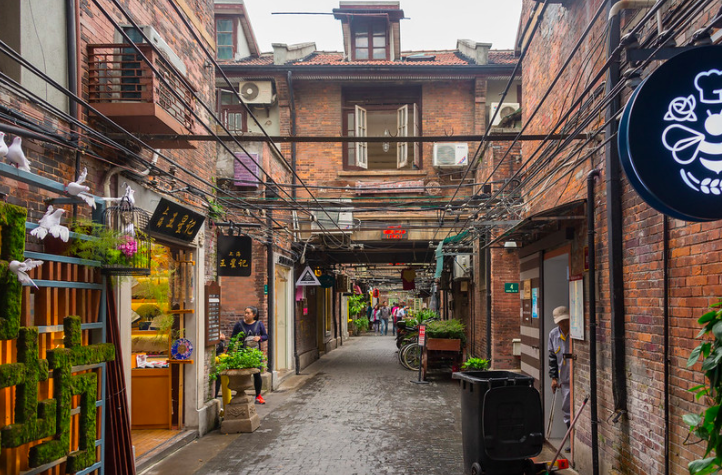
Tianzifang’s maze of fairy-lit alleyways is well worth an evening visit, too – sitting outside on plump cushions, sipping wine and gazing up through narrow brickwork to a sliver of star-lit sky is hard to beat – but, for now, we’ll stick to the most important meal of the day. The choice is delightfully overwhelming, but we’d recommend kommune, a Shanghai institution that’s been serving artsy locals and hipster expats for close to 20 years. Hidden away in the lanes behind Taikang Lu, tables out front are great for people watching, and the breakfast menu is well-loved for a reason (smoked salmon bagels, smashed avocado, shakshuka and smoothies are all in attendance) – but it’s the coffee and cocktails that really keep people coming back.
Spot of culture: Next, head for People’s Square, roughly an hour’s walk or 20 minutes on the metro. You might expect the People’s Square in Shanghai to be far more impressive than its less-eminent counterparts throughout China. On the contrary, it is little more than a large, tree-covered park, a green oasis in the midst of towering steel, home to a small oriental garden, a miniature fun fair, Shanghai Art Museum and the station at the crux of the city’s metro system. Nice though it is, the square’s real distinctiveness stems from the sprawling (and initially invisible) shopping mall which lies beneath it.

Accessible from the metro station itself (at the south end of the line 1 exit), the mall (or, technically speaking, malls: Shanghai Traditional Street in 1930s; Hong Kong Famous Shops Street; and Dmall Shopping Center) occupies two subterranean floors filled with row upon row of glass-walled boutiques, selling a bountiful variety of clothes, shoes and accessories, all of passable quality, at ridiculously low and extremely negotiable prices. Spend a few hours getting lost here and making impulse purchases – it’s an essential part of any trip to the so-called Paris of the East.
Lunch
If the overbearing shopping centres and five-floor department stores lining Nanjing Road start to close in on you, there’s only one thing to do. Contrary to expectation, the wide pedestrianised street is not the centre of an inescapable network of identical thoroughfares, but is, fascinatingly, laced with narrow tributaries, tiny residential alleyways, each revealing elderly Chinese women hanging laundry, wooden tubs filled with steaming dumplings, bicycles leant haphazardly against walls and the omnipresent scattering of stray cats and dogs dashing from open doorway to open doorway. Truly, it’s like being in the backstreets of a tiny town, with the frenetic buzz of Nanjing Road still echoing but a street away.

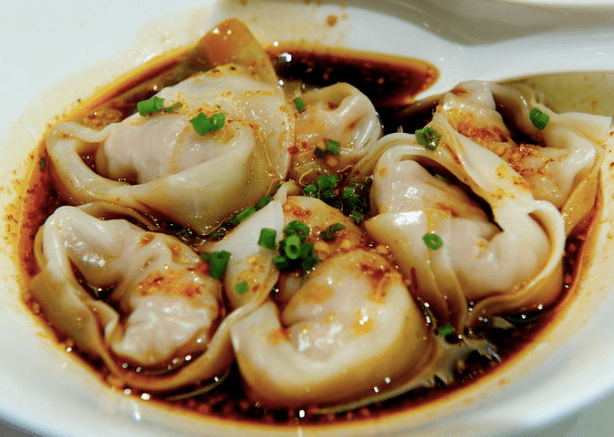
When you can no longer resist the tempting smells wafting from bamboo steamers stacked high, head for Shanghai Snack (183 Shanxi S Road, just off Nanjing Road East). Glamorous it ain’t, but this little eatery – with its plastic moulded seats and stark white walls – is widely regarded as the purveyor of Shanghai’s finest dumplings. Order a generous helping of sheng jian bao (Shanghai’s much-loved pan-fried baozi) and xiao long bao (steamed, soup-filled dumplings which also originated here).
A spot of culture: The Bund Sightseeing Tunnel is neither historic nor highbrow. It is, however, one of the more bizarre experiences you will ever have, and thoroughly worth twenty minutes of your time and 50RMB of your budget. In order to travel from the Bund (the old business centre of Shanghai, lined with austere sandstone colonial buildings belonging to the likes of Armani and Citibank) to Pudong (the new financial centre and home to the city’s oft-photographed scraper-scape), pedestrians must cross the Huangpu River. To do this, you can either walk back several blocks to the metro stations on Nanjing Road or, if you’re feeling adventurous and flush, follow an escalator on the riverbank one floor underground and board the transparent, driverless cable car which takes you along a short track and through the tunnel. All very normal, until the pod passes through the first of several black curtains.

Like a weird and wonderful theme park ride, you glide smoothly through a brightly lit channel, accompanied by peculiar – and oddly hypnotic – music and stream of audio claiming that you are currently passing through magma (the walls of the channel become screens playing footage of oozing magma), hell (the light beams return, become unbearably bright and begin to flash), paradise (the neon beams become soothing again, then some air-filled puppets designed to look like manically waving clowns innocuously bump the car as it passes them). Eventually, another curtain appears ahead, this one displaying footage of sharks, until the car passes through it and you find yourself ejected from the pod, ushered towards more escalators and, finally, standing bemusedly on the streets of Pudong. For reasons not yet clear to anyone, it is something of a must-have experience – if only because it is frankly impossible for description alone to do it justice. Trippy? Yes. Unmissable? Also yes.

Dinner
For dinner, China’s international metropolis demands that you feast – and if your trip includes only one truly extravagant act, let it be a stop at Din Tai Fung. There are now more than 150 branches of this upmarket Taiwanese restaurant chain around the world, ten of which are in Shanghai – but since you’re here, opt for the most impressive of the bunch, on the third floor of the towering World Financial Centre.
Yes, that’s right, third floor, so you won’t find any grand sweeping views here – but you’ll have far more important things to focus on. Din Tai Fung is known for its dumplings (its xiao long bao in particular), but don’t ignore the rest of the menu; the spicy shrimp chaoshou, vegetable dishes, fried spare ribs and hairy crab are also well worth investigation. As in many a Chinese fine-dining establishment, you might find the service almost too officious (staff hover obediently and swoop in to remove newly empty plates with lightening reflexes), but this can be a blessing in disguise when a spicy morsel has you in urgent need of your next beer.
Drinks
The Chinese love nothing so much as neon. Every building is coated with it – neon signs, neon lamps, neon screens; you name it – and, after sunset, Shanghai sparkles like the window of a costume-jewellery store, feverishly painting streaks of iridescent light across a matrix of streets and concrete. Those after the best view of the city after dark head for the observation decks of the city’s three tallest buildings – the JinMao Tower, Shanghai World Financial Centre (affectionately known as the Bottle Opener) and, the tallest as of 2015, the Shanghai Tower – which stand at a not-to-be-sniffed-at 421m, 492m and 632m respectively. But if ticket prices and snap-happy tourist throngs don’t appeal, never fear: there is a charming alternative.
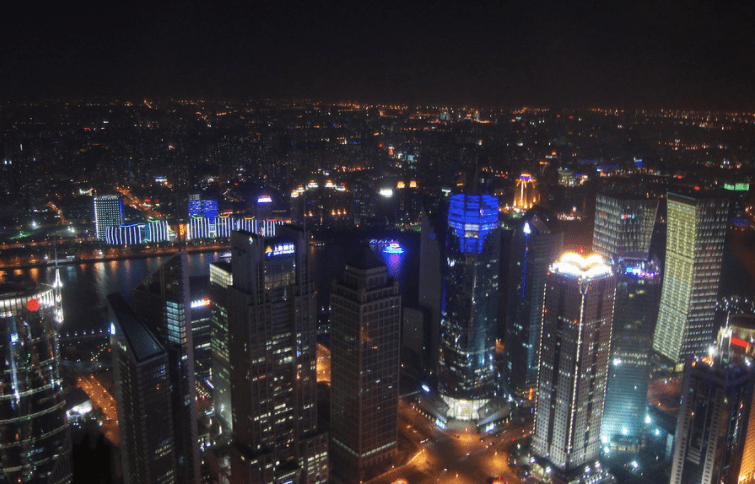
On the 87th floor of the JinMao Tower, in the sleek upper reaches of the Grand Hyatt Shanghai, lies Cloud 9, an enigmatic skybar offering spectacular 360-degree views over the city in all its nightly splendour. Needless to say, this is an exclusive spot, and emphatically designed to remain that way. Reaching it involves navigating three elevator changes – take the first to the 54th floor, cross the hotel reception and take the next to the 85th, then go right, into the third set of lifts, and up to the 87th – and there is a 150RMB (£15) minimum spend, but a moment spent gaping through the vast floor-to-ceiling windows, cocktail in hand, is well worth the cost and effort.
 Glug & Chew